TL;DR

Get kitchen staples and gadgets delivered free with Prime
- Fast, free delivery on millions of items
- Prime Video, Amazon Music and more included
- Member-only deals all year
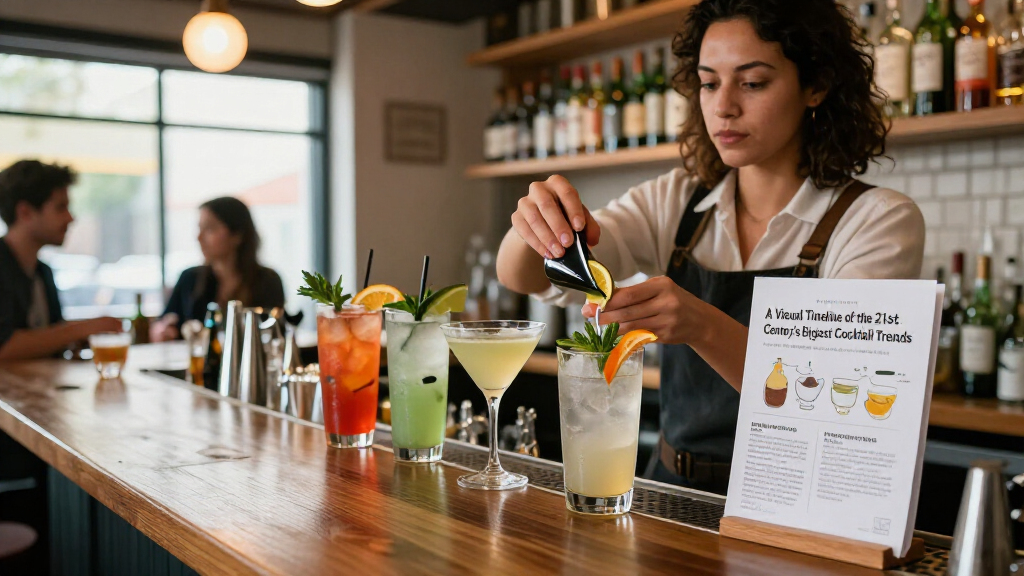
VinePair published a visual timeline of 13 cocktail trends that shaped the past quarter-century, using the 1999 opening of New York’s Milk & Honey as its starting point. The report follows the revival of historic drinks, fat-washing, bar gadgets and other shifts, while acknowledging that trend dates are approximate and some techniques remain in use.
VinePair has published a visual timeline of 13 cocktail trends that shaped drinking culture in the 21st century, tracing the modern craft cocktail revival from the opening of New York’s Milk & Honey on Dec. 31, 1999, to techniques and bar tools still in use today. The report matters as a compact account of how bartenders moved from reviving historic recipes toward experimentation with ingredients, equipment and presentation.
The timeline begins with what VinePair describes as the old-school drink revival, which it dates from 2000 to 2015. In the years after Milk & Honey opened, bartenders rediscovered recipes from older cocktail books and brought drinks including the Sazerac, Negroni, Bee’s Knees and Last Word back into wider use. VinePair says the revival helped establish those drinks as enduring classics, even as bartenders moved on from the period’s vintage styling.
A second trend, fat-washing, is dated from 2007 to 2019. The report credits Don Lee of New York’s PDT with a prominent early example: the Benton’s Old Fashioned, made with bourbon infused with bacon fat sourced from chef David Chang, then combined with maple syrup. Bartenders later experimented with other fats, including duck fat and butter. VinePair says the method receded somewhat before the pandemic but remained in use and became more familiar.
The timeline also follows the spread of bar gadgets and technical methods. Smoking guns and iSi siphons, initially associated with more specialized programs, became more common around 2015, according to the report. VinePair points to the flavor blaster’s smoky bubbles as a popular feature around the pandemic years and notes that Dave Arnold’s Spinzall centrifuge, introduced in 2017, helped bartenders clarify drinks and carry out techniques such as fat-washing. Another short-lived visual fashion was attaching tiny clothespins to cocktail glasses, which the report dates to around 2017 to 2019.
How Bar Techniques Became Mainstream
The timeline shows a shift in what counted as innovation behind the bar: researching and restoring old recipes gave way to applying scientific methods and specialized equipment, while presentation also became part of the guest experience. Those changes help explain why techniques once associated with a small group of influential bars later appeared in wider use.
For readers, the retrospective offers a way to recognize the influences behind familiar drinks and contemporary bar practices. It also cautions against treating every fashion as a lasting change. Some trends faded, others became standard tools, and the report presents the period as a mix of temporary styles and durable techniques.
Popular right now

LG 77-Inch OLED evo C6 4K Smart TV

Apple AirPods Pro 3 Wireless Earbuds with Active Noise Cancellation

Dyson V8 Cyclone Cordless Vacuum
As an affiliate, we earn on qualifying purchases.
From Milk & Honey to Modern Bars
VinePair identifies Milk & Honey’s opening on Dec. 31, 1999, as the touchstone for the modern craft cocktail revival. The report also names earlier influences, including bartender Dale DeGroff’s work at the Rainbow Room, the original Angel’s Share opening in 1993 and the growth of London’s cocktail-bar scene during the 1990s. Its timeline treats the turn of the century as a useful marker, not as the only beginning of cocktail innovation.
The article groups its trends into overlapping periods rather than claiming that each began or ended on an exact date. It says the history is difficult to pin down precisely, and describes the timeline as a rough account of the cocktail scene’s most pervasive shifts over roughly 25 years.
““It can be difficult to pin down the exact moment these trends took off or faded away.””
— VinePair
Trend Dates Remain Approximate
The report does not establish a single definitive date when each trend began or ended. Its ranges are editorial estimates, and some developments overlap: fat-washing, for example, is described as less prominent before the pandemic but still practiced afterward. The source also does not provide survey data or market measurements to quantify how widely each technique spread.
The source material supplied here includes only part of the timeline’s discussion: it ends during the account of the clothespin trend. Although VinePair says the infographic covers 13 trends, the available text does not identify all 13, so this account cannot list or assess every item shown in the graphic.
The Timeline Looks Ahead
VinePair frames the retrospective as a prompt to watch how cocktail culture develops through the century’s next quarter. The report does not name a specific upcoming trend, publication date or industry milestone. For now, its forward-looking point is that the field’s mix of historical research, experimentation and presentation leaves room for further crossovers with art, history and science.
Readers seeking the complete list can consult the original VinePair infographic and article. Any assessment of which trends endure will depend on how bartenders and bars continue to use these techniques over time.
Key Questions
What is the timeline about?
It is VinePair’s retrospective of 13 cocktail trends that influenced drinking culture from the turn of the century to the present.
Why does the timeline start in 1999?
VinePair uses the opening of New York’s Milk & Honey on Dec. 31, 1999 as a touchstone for the modern craft cocktail revival, while also noting earlier influences.
What is fat-washing?
It is a method of infusing spirits with fat to add flavor and texture. VinePair highlights Don Lee’s Benton’s Old Fashioned, made with bacon-fat-infused bourbon, as a prominent example.
Are the dates in the timeline exact?
No. VinePair describes the timeline as a rough account and says it can be difficult to pinpoint when trends took off or faded.
Does the report say which cocktail trend comes next?
No specific next trend is named. The report looks ahead generally, pointing to continued experimentation and possible connections with art, history and science.
Source: vinepair.com