
When a household wants cookware that aligns with halal requirements, the utensil drawer is easy to overlook. Unlike food itself, utensils raise subtler concerns: animal-derived additives in plastics, bovine bone char used in some pigment processing, glues and coatings of questionable origin, and cross-contact with non-halal cooking in shared kitchens. This comparison looks at the two dominant paths buyers face: an inexpensive nylon-and-silicone halal utensil set, and a premium set built around stainless steel cores, certified food-grade silicone, or natural wood. The core tension is not just price. It is whether formal halal certification, longer lifespan, and safer materials justify paying three to four times more — or whether a carefully vetted budget set does everything a halal-conscious kitchen actually needs. If you cook daily, use nonstick pans, and want traceable certification, the premium route earns its cost. If you cook occasionally and are comfortable verifying materials yourself, the budget set is the smarter buy.

Get kitchen staples and gadgets delivered free with Prime
- Fast, free delivery on millions of items
- Prime Video, Amazon Music and more included
- Member-only deals all year
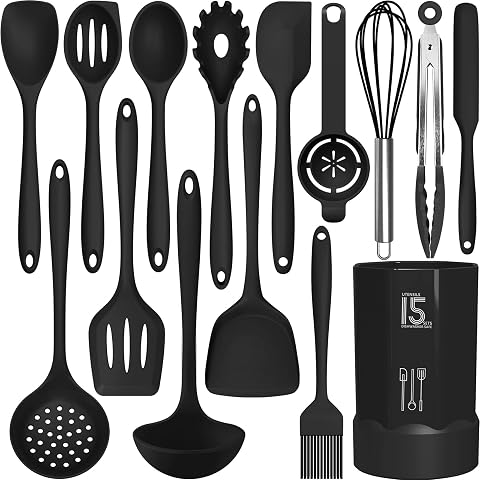
AOTHOD Silicone Cooking Utensil Set, 15 Pieces
- ✔ Brand: AOTHOD
- ✔ Material: Food-grade, BPA-free silicone with stainless steel reinforcement
- ✔ Heat Resistance: Up to 446°F
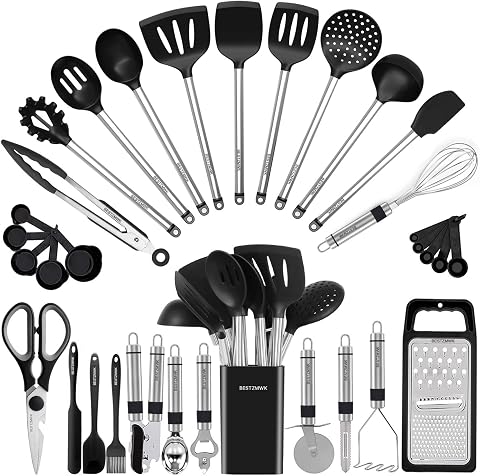
33-Piece Silicone Kitchen Utensil Set with Stainless Steel Handles
- ✔ Brand: BESTZMWK
- ✔ Model Number: EP216
- ✔ Piece Count: 33

Silicone Cooking Utensils Set – 10 Piece, 600°F Heat Resistant, BPA Free, Dishwasher Safe, Black
- ✔ Material: Food-grade silicone with stainless steel core
- ✔ Heat Resistance: Up to 600°F
- ✔ Pieces Included: 10
At a Glance
| Criteria | Budget Halal Utensil Set (nylon/silicone, ~$20-35) | Premium Halal Utensil Set (stainless steel core silicone / wood, ~$60-120) | Winner |
|---|---|---|---|
| Halal certification and traceability | Often self-declared or no formal certification; buyer must verify materials | Formal halal/food-safety certification from recognized bodies in many cases | |
| Material safety and animal-free composition | Food-grade nylon/silicone but additives rarely documented | Documented animal-free silicone, stainless, or certified wood finishes | |
| Heat resistance | Typically 200-230°C, nylon heads can deform near pan edges | 230-260°C+; silicone and steel withstand sustained high heat | |
| Durability and lifespan | 1-2 years of regular use before staining, warping, cracking | 5+ years; replaceable heads on some premium lines | |
| Nonstick cookware compatibility | Good — soft heads protect coatings | Good — silicone heads; steel tools require care on coatings | |
| Variety and completeness | Usually 10-15 pieces, covers basics well | Often 12-24 pieces including specialized tools | |
| Maintenance and hygiene | Dishwasher safe but stains and absorbs odors over time | Dishwasher safe, resists staining and odor absorption | |
| Price and value | $20-35, low commitment | $60-120, higher upfront cost |
AOTHOD Silicone Cooking Utensil Set, 15 Pieces
The AOTHOD 15-piece set hits the balance point that most halal home cooks actually need. It covers the full workflow of a typical halal meal — basting marinated chicken, serving rice, draining pasta, flipping kebabs — without the filler that pads out larger kits. Every tool pairs BPA-free silicone with stainless steel reinforcement, so nothing bends under a heavy pot of biryani, and the seamless construction means there are no joints where residue from one dish can linger into the next.Compared with the 33-piece BESTZMWK set, AOTHOD gives up breadth — no measuring cups, no pizza cutter, no peeler — but what you give up in gadget count you regain in storage sanity and per-tool quality. Its 446°F heat rating trails the 10-piece set’s 600°F, which matters mainly if you do a lot of high-heat searing; for everyday sautéing, simmering, and baking it’s more than adequate. The included utensil holder and egg separator are thoughtful touches that most competitors skip.The honest drawback is size: fifteen pieces plus a holder still demands real counter or drawer space, and anyone in a compact apartment kitchen may find it more than they need. But for a household that cooks halal meals daily and wants one purchase to cover it all, this is the most sensible starting point in the lineup.
Pros:
- Heat-resistant up to 446°F, enough for everyday frying and baking
- Seamless design prevents food traps — easier to keep halal-compliant and sanitary
- Silicone heads won’t scratch nonstick cookware
- Includes genuinely useful extras like a utensil holder and egg separator
Cons:
- Fifteen pieces plus holder requires meaningful storage space
- Heat rating falls short of the 10-piece set’s 600°F for intense searing
Best for: Halal households that cook daily and want broad tool coverage without a bloated 33-piece kit
Not ideal for: Minimalist cooks or tiny kitchens where fifteen pieces is simply too much
Bottom line: The most balanced pick here: broad enough for a real halal kitchen, focused enough to avoid clutter.
“The most balanced pick here: broad enough for a real halal kitchen, focused enough to avoid clutter.”
33-Piece Silicone Kitchen Utensil Set with Stainless Steel Handles
If you’re starting a halal kitchen from zero — new apartment, first home, or a kitchen refresh — the BESTZMWK 33-piece set is the most efficient way to check every box at once. Beyond the usual spatulas, tongs, and ladle, you get measuring cups, measuring spoons, a peeler, and a pizza cutter, which are the items that quietly push the total cost up when bought separately. That’s where the value argument lives.Its construction is also distinct in this lineup: 304 stainless steel handles paired with silicone heads. Compared with AOTHOD’s fully silicone build, that translates to noticeably stiffer tools that won’t flex when stirring thick stews or lifting heavy roasts — a real advantage for cooks who found all-silicone utensils too yielding. The hanging holes on every tool let you store the set vertically, which partially offsets the sheer piece count.The tradeoff is honesty about weak links: the included utensil holder is flimsier than the tools themselves, and a 33-piece set is simply too much for a household that cooks occasionally. Compared with the 10-piece pick, this set prioritizes coverage over specialization — it’s the kitchen-equivalent choice, not the enthusiast’s choice. But if you’d otherwise buy these tools one by one, the math here is hard to argue with.
Pros:
- Complete 33-piece coverage includes measuring cups, spoons, peeler, and pizza cutter
- Rigid 304 stainless steel handles resist bending, breaking, and rusting
- Non-scratch silicone heads protect nonstick cookware
- Hanging holes allow compact vertical storage despite the large piece count
Cons:
- The included utensil holder is noticeably flimsier than the utensils themselves
- Thirty-three pieces is overkill for small kitchens and infrequent cooks
Best for: Anyone equipping a new halal kitchen from scratch who wants every tool in one purchase
Not ideal for: Small households or occasional cooks who’ll use a fraction of the pieces
Bottom line: The best per-tool value if you need a complete halal kitchen in one box — just plan your own storage.
“The best per-tool value if you need a complete halal kitchen in one box — just plan your own storage.”
Silicone Cooking Utensils Set – 10 Piece, 600°F Heat Resistant, BPA Free, Dishwasher Safe, Black
Halal cooking leans heavily on high-heat techniques — searing beef, shallow-frying samosas, charring kebabs — and that’s exactly where the 10-piece 600°F set separates itself. Its heat resistance is the highest in this lineup, comfortably ahead of AOTHOD’s 446°F, meaning you can rest a tool against a hot pan edge without worrying about melting or warping. For cooks who’ve ruined silicone spatulas on a scorching skillet before, that margin is the whole pitch.The fully seamless, one-piece silicone build over a stainless steel core is the strongest sanitation story of the three picks — no handle joints, no crevices, nothing that traps residue between halal and non-halal dishes. In exchange, you accept the set’s limits: ten tools cover essentials like a ladle, spoonula, whisk, tongs, and basting brush, but there’s nothing for measuring or specialty prep. Where the BESTZMWK set is breadth-first, this one is depth-first on the tools that touch heat.The main compromise is feel. All-silicone tools flex more than metal-handled alternatives, so heavy stirring jobs can feel less controlled than with the BESTZMWK set, and the black-only colorway won’t suit every kitchen aesthetic. Still, for the cook whose priority is a compact, heat-proof, easy-to-sanitize core set, this is the tightest package of the three.
Pros:
- 600°F heat resistance — the highest of the three sets — prevents melting and warping
- Fully seamless design eliminates joints where food residue can hide
- Stainless steel core keeps tools from deforming over time
- Compact ten-piece footprint fits small kitchens and minimal drawers
Cons:
- All-silicone tools feel less rigid than the metal-handled BESTZMWK set
- Available only in black
- No measuring or specialty tools included
Best for: Cooks who sear, fry, and baste at high temperatures and want a compact heat-proof core set
Not ideal for: Cooks who prefer rigid metal handles or want measuring and specialty tools included
Bottom line: The high-heat specialist: fewer tools, but the ones that matter most when the pan is screaming hot.
“The high-heat specialist: fewer tools, but the ones that matter most when the pan is screaming hot.”
As an Amazon Associate we earn from qualifying purchases.
Key Differences
The first real difference is certification. Budget sets frequently rely on the seller’s word that materials are halal-appropriate. In practice, food-grade silicone and nylon are almost always plant- or mineral-derived, so the halal risk is low, but low risk is not the same as documented assurance. Premium sets from established brands more often carry certification from recognized bodies or at minimum publish full material disclosures, which matters if you want certainty rather than reasonable confidence. For households where certification is a hard requirement — for example, catering for guests, or running a home kitchen with strict standards — this gap alone can decide the purchase.
The second difference is longevity, and it compounds. A budget set’s nylon heads warp, silicone stains orange from turmeric-heavy cooking, and handles loosen within a couple of years of regular use. A premium set with fiberglass-reinforced silicone and full-tang stainless handles largely resists all three. Over five years, buying two or three budget sets can approach the cost of one premium set, which erodes the savings — though not completely, since even the priciest utensil set rarely exceeds the cost of one decent pan.
The third difference is heat behavior. This matters more in halal home cooking than many buyers expect, because cuisines that dominate halal kitchens — South Asian, Middle Eastern, Southeast Asian — involve high-heat searing, deep frying, and long simmered sauces. Budget nylon tools soften and shed microplastic particles near hot pan walls. Premium silicone and steel tolerate sustained heat without degradation. If you deep-fry or sear regularly, this is a genuine safety and durability issue, not a luxury feature.
Detailed Comparison
Premium sets more often carry formal halal or food-contact certification, and reputable brands publish material composition down to pigments and coatings — the exact components where animal-derived inputs (bone char pigments, animal-based stearates) can hide. Budget sets typically state ‘BPA-free’ and little else. The practical consequence: with the budget set you are doing your own verification, emailing sellers, and accepting some uncertainty; with the premium set the paperwork largely exists already. The premium set wins, but the gap is moderate rather than major, because mainstream food-grade silicone and nylon are, in practice, overwhelmingly free of animal-derived ingredients. Certainty, not safety, is what you are buying.
Both categories are broadly safe for food contact, but composition quality differs. Budget sets sometimes mix nylon and silicone with unclear additives and cheaper handle plastics that degrade faster. Premium sets favor platinum-cured silicone (more stable than peroxide-cured), 304 stainless steel, and natural woods like olive or acacia with food-safe finishes. If your concern is specifically avoiding any possibility of animal-derived processing agents, premium sets with documented platinum-cured silicone and unfinished or certified-finished wood are the cleaner answer. The gap is real but modest for everyday home cooking.
This is where premium sets pull ahead most clearly. Budget nylon tools are rated around 200°C but deform when rested against a hot pan edge during searing; degraded nylon can also shed particles into food. Premium silicone handles 230-260°C sustained, and stainless tools are effectively immune. For halal kitchens doing regular high-heat cooking — biryanis, fried samosas, seared meats — this is a major practical difference. For occasional pasta stirring and gentle sautéing, it barely matters.
Budget sets last one to two years of regular use before showing staining, warped heads, and loose handles. Premium sets routinely last five years or more, and some offer replaceable heads so the steel handles outlast the tools attached to them. Factoring replacement cycles, the premium set’s cost-per-year is often comparable to or better than the budget set’s. The budget set only wins on durability if you cook rarely enough that degradation never catches up with you.
Nonstick cookware compatibility (Budget Halal Utensil Set (nylon/silicone, ~$20-35) wins — minor)
Budget sets are almost entirely soft-headed, which makes them inherently nonstick-friendly — arguably their strongest suit. Premium sets usually mix silicone-headed tools with bare stainless pieces (skimmers, solid spoons), which will scratch nonstick coatings if used carelessly. If your kitchen runs mostly nonstick pans, the budget set is actually the safer default, or you need the discipline to keep steel tools away from coated surfaces. A narrow but genuine win for the budget set.
Both categories offer complete starter assortments — slotted spoon, solid spoon, spatula, ladle, tongs. Premium sets tend to go further, including specialized tools like soup ladles with pour lips, wire skimmers useful for frying, and larger counts (up to 24 pieces). Budget sets cover the essentials but often pad piece counts with duplicates or rarely-used tools. The premium set offers more genuinely useful variety; the budget set offers adequate variety. Moderate gap, mostly relevant if you cook a wide range of dishes.
Both are dishwasher safe in most configurations, but budget silicone and nylon stain permanently from turmeric, tomato, and chili — a near-universal experience in halal-heavy cuisines — and can retain odors. Premium silicone resists staining far better; stainless and wood (hand-washed) stay hygienic indefinitely. Staining is cosmetic, but odor retention is a hygiene concern in a kitchen that also avoids strong flavor cross-contamination between dishes. Moderate gap in favor of premium.
Price and value (moderate difference)
Budget sets cost $20-35 and deliver perhaps 80% of the functional utility. Premium sets cost $60-120 and deliver the remaining 20%: certification, heat tolerance, longevity, stain resistance. Whether that 20% is worth triple the price depends entirely on cooking frequency and certification needs. For a daily-cooking household, the premium set’s cost-per-year often wins. For a weekly-cooking household, the budget set is plainly better value. This criterion genuinely depends on the buyer.
Budget Halal Utensil Set (nylon/silicone, ~$20-35): Pros and Cons
Pros:
- Very low upfront cost with low commitment
- Entirely soft-headed — safe for all nonstick cookware
- Covers all essential tools in one purchase
- Easy to replace individual pieces cheaply
- Widely available and easy to gift or outfit a second kitchen
Cons:
- Halal suitability usually self-declared, not certified
- Nylon heads deform with high-heat cooking
- Permanent staining and odor absorption from spices and tomato
- Typical lifespan of one to two years with regular use
- Piece counts sometimes padded with low-quality extras
Pros:
- Formal halal or food-contact certification more commonly available
- Higher heat resistance suited to searing and deep frying
- Five-plus year lifespan with replaceable heads on some lines
- Resists turmeric and tomato staining
- Full material disclosure from established brands
Cons:
- Three to four times the upfront cost
- Stainless pieces can scratch nonstick pans
- Wood components require hand washing and occasional oiling
- Certification varies by brand — must be verified per product
- Overkill for occasional cooks
Who Should Choose What
Choose Budget Halal Utensil Set (nylon/silicone, ~$20-35) if:
- You cook a few times a week or less and use mostly nonstick pans
- You are comfortable verifying material safety yourself and do not need formal certification
- You are outfitting a student flat, holiday home, or gift on a tight budget
- You want to test which utensil shapes you actually use before investing more
Choose Premium Halal Utensil Set (stainless steel core silicone / wood, ~$60-120) if:
- You cook daily, especially high-heat dishes like seared meats, fried snacks, and long-simmered curries
- Formal halal certification or documented animal-free materials are a requirement, not a preference
- You are tired of replacing stained, warped utensils every year or two
- You cook spice-heavy cuisines and want utensils that do not hold color and odor
Skip both if: You cook professionally or in large volumes — buy individual commercial-grade tools (steel skimmers, heavy silicone spatulas) à la carte instead of any boxed set, and source certified wood cutting and serving pieces separately.
Value for Money
Is paying three to four times more worth it? For daily cooks, yes — and the arithmetic supports it. A $25 budget set replaced every 18 months costs roughly $70-85 over five years, while a $90 premium set likely survives that entire period and stays stain-free and heat-safe throughout. Cost-per-year converges, and the premium set is better to use the whole time. For occasional cooks, the math reverses: a budget set that sees weekly use may last four or five years anyway, making the premium set’s advantages largely theoretical. The honest value split is this: the premium set is the better purchase for anyone who cooks most days or needs certification on paper; the budget set is the better purchase for everyone else. Do not pay the premium for piece count alone — a 24-piece set you use eight pieces from is worse value than a 12-piece set you use fully.
Final Verdict
For most halal-conscious households that cook regularly, the premium set is the better long-term purchase: it delivers documented material assurance, survives the high-heat, spice-heavy cooking that dominates halal kitchens, and avoids the annual replacement cycle that quietly erodes the budget set’s price advantage. Choose the budget set if you cook occasionally, rely on nonstick pans, and are willing to verify halal-appropriate materials yourself — it will do the job honestly and cheaply. The single biggest deciding factor is cooking frequency and heat: if your week involves frying, searing, or daily curry pots, buy premium; if it involves occasional gentle cooking, buy budget and stop worrying about it. One caution applies to both: certification claims vary brand by brand, so whatever you pay, check the actual product listing for certification or material disclosure rather than trusting the word ‘halal’ in the title.
Frequently Asked Questions
What actually makes a cooking utensil set ‘halal’?
The main concerns are animal-derived components — certain pigments processed with bone char, animal-based stearates used as plastic additives, and glues or finishes of unclear origin — plus cross-contact with non-halal food. Most food-grade silicone, nylon, stainless steel, and unfinished wood are inherently free of animal inputs, which is why utensils are a lower-risk category than food itself. Formal halal certification removes the remaining uncertainty.
Are silicone utensils automatically halal-safe?
Silicone is synthetic and almost always animal-free, so it is broadly halal-appropriate. The residual risk sits in pigments and any coatings, which reputable brands disclose. If you want certainty rather than high probability, look for certification or a published material statement — more common on premium sets than budget ones.
Is a budget set unsafe if it lacks certification?
Not necessarily unsafe — most likely it is fine. Lack of certification means unverified, not non-halal. If you buy a budget set, choose plain-colored silicone or nylon pieces from a seller who answers material questions, and avoid products with vague listings or strong chemical odors on arrival.
Which set is better for nonstick pans?
The budget set, in most cases. Its all-soft construction cannot scratch coatings. Premium sets that include bare stainless tools require care — use only the silicone-headed pieces on nonstick surfaces. If nonstick is your entire cookware collection, prioritize soft-headed sets in either price tier.
How many pieces do I actually need?
Most households use five or six tools daily: a solid spoon, slotted spoon, spatula, ladle, tongs, and a skimmer if you fry. A 10-12 piece set covers this comfortably. Larger sets are only worth it if you genuinely cook a wide repertoire; otherwise the extra pieces just occupy drawer space.
Fall Picks
fall essentials
As an affiliate, we earn on qualifying purchases.