
TL;DR

Get kitchen staples and gadgets delivered free with Prime
- Fast, free delivery on millions of items
- Prime Video, Amazon Music and more included
- Member-only deals all year
IdeaClyst acts as a digital war room for your ideas. It combines AI-driven critique, discovery, and planning, all stored locally for privacy and control. It helps founders move swiftly from insight to action, avoiding costly missteps.
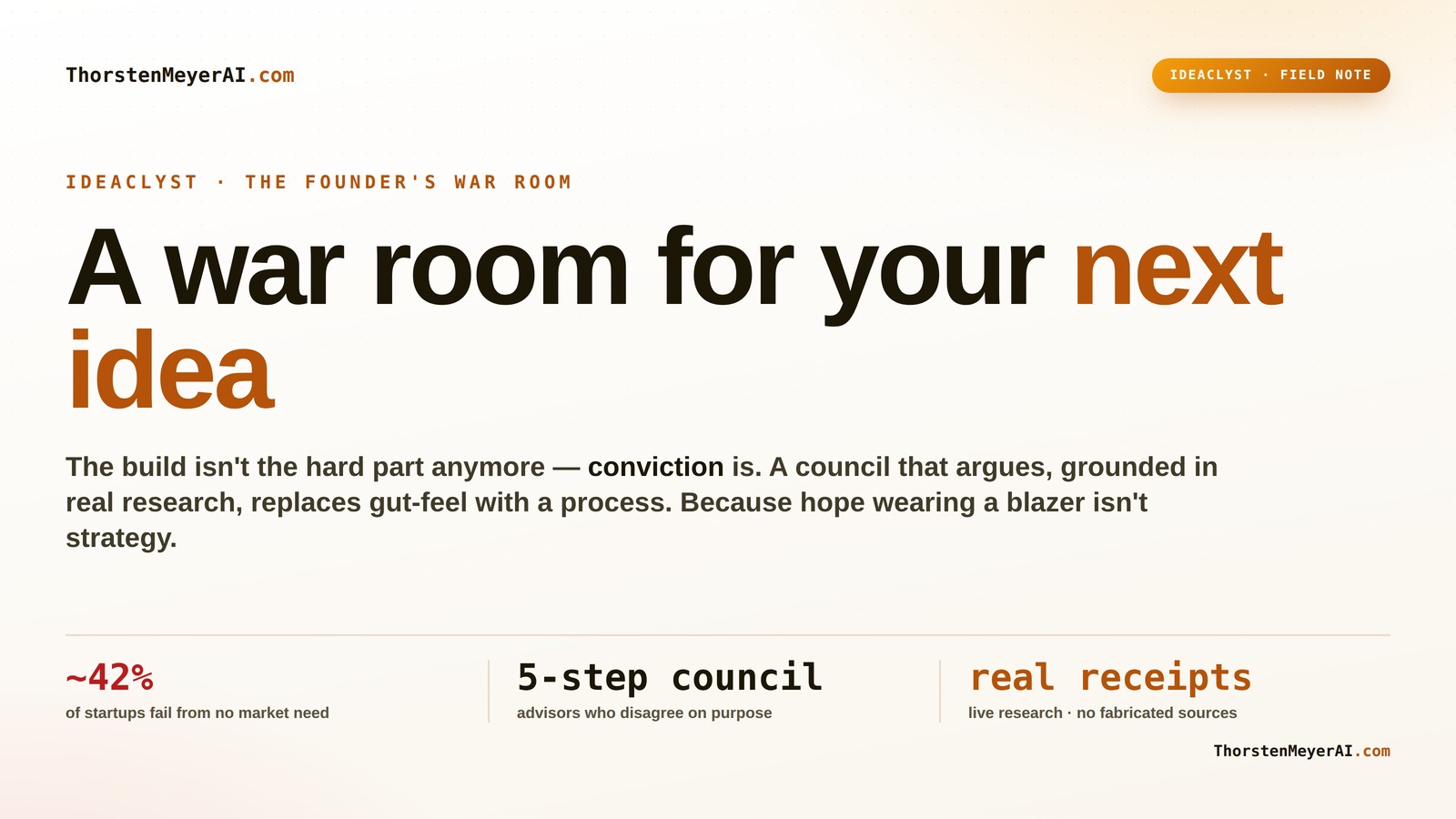
A war room for your next idea
The build isn’t the hard part anymore — conviction is. Knowing which idea deserves the next six months, and being able to defend it. Most founders answer with gut feel and optimistic math. That’s hope wearing a blazer. IdeaClyst replaces it with a process.
The most expensive decision is what to build
The single most valuable thing a tool can do is talk you out of the wrong six months. The numbers make the case better than any pitch.
Three tools in one — on your own machine
Strip away the framing and IdeaClyst is three things at once, all running locally with nothing leaving your laptop.
An AI council
Pressure-tests an idea you bring it — advisors who argue on purpose.
A discovery engine
Finds ideas you didn’t know to look for by hunting real demand signals.
A founder’s workspace
Carries winners from “interesting” all the way to “ready to build.”
Advisors who disagree on purpose
Not one confident, agreeable answer — a structured five-step deliberation where models play different roles and turn on their own work. The disagreement is the feature.
The five-step deliberation
A council that leads with the bad news surfaces the objections you’d otherwise find the expensive way, on month five.
Product strategy
Who’s it for, what’s the wedge, why now, what’s the business model.
Technical architecture
What would it actually take to build — and where’s the risk.
Critique pass
The council turns on its own work. Where’s the hand-waving? What kills this?
Second, independent critique
A different voice, a different angle — so blind spots don’t survive.
Final synthesis
Everything into one coherent founder packet: strategy, architecture, validation, plan.
When IdeaClyst cites a source, it actually fetched it
The hard departure from “ask an AI what it thinks of my startup.” It runs in a strict, real-data-only mode — if it can’t gather genuine evidence, it says so plainly rather than inventing a plausible paragraph.
Confidence with receipts
No fabricated statistics, no imaginary competitors, no made-up citations. The packet survives a skeptical co-founder or a sharp investor because the reasoning has receipts.
Market research first
Scouts the landscape before the council reasons about anything.
Competitor read
Real positioning, pricing signals, feature claims — differentiation vs. reality.
Validation with links
Not “talk to customers” — concrete signals & sources you can click.
From the blank page to build-ready
Evaluation is half the problem; the blank page is the other half. And a plan is worthless if it dies in a tab you never reopen.
Bring a space, not an idea
“AI for accountants,” “tools for indie game studios” — plus your goal and real capacity. It hunts demand signals across HN, Reddit, Product Hunt, GitHub, pricing pages.
- An honest market read — leads with the bad news when a space is hard
- An opportunity map — high pain, thin competition
- Ranked candidates — wedge, who pays, effort, risk, confidence
- each with KILL CRITERIA — when to walk away
A home and a forward path
Every promising idea gets carried forward, with every artifact in plain files on your disk.
- Validation tooling — sprint board, interview list, evidence browser
- Founder profile — a personal-fit lens; same discovery, different advice
- Build workspaces — funnel, personas, landing draft, version history
- “Build this idea” → a PRD + task queue, ready for a coding agent
Key Takeaways
- A digital war room like IdeaClyst centralizes idea critique, discovery, and planning, keeping everything private and controlled on your local machine.
- Structured debates among AI models surface potential flaws early, saving months of costly mistakes.
- Focus your war room on strategic content: research, visuals, critiques, and clear next steps to ensure progress.
- Daily updates and consistent review turn chaos into clarity, speeding up decision-making.
- Both physical and digital war rooms have their place, but digital setups excel for remote, private, and flexible work.
As an affiliate, we earn on qualifying purchases.
What Exactly Is IdeaClyst and Why Should You Care?
IdeaClyst is a local-first toolkit that acts as your personal digital war room. It’s a place where your ideas get pressure-tested by AI advisors, expanded through discovery engines, and shaped into actionable plans. Think of it as the secret headquarters for your startup’s next leap.
Unlike typical brainstorming tools, IdeaClyst’s core strength is its structured council—multiple AI models that debate your idea from different angles, surfacing flaws you might overlook. This push-and-pull mimics a real-world team of diverse advisors, but all within your own laptop. This structure matters because it ensures your ideas are rigorously challenged, revealing weaknesses early and reducing the risk of costly pivots later. The tradeoff, however, is that it requires a mindset shift—trusting AI models to critique your ideas as thoroughly as human advisors would, which can be uncomfortable but ultimately more comprehensive.
Why a Digital War Room Supercharges Your Idea Development
A war room centers everything—research, sketches, notes—so your team can see progress at a glance. IdeaClyst replicates that online, giving you a dedicated space to focus entirely on shaping your idea without distractions.
For example, a founder working on a new SaaS product can use IdeaClyst to map out customer needs, technical risks, and business models in a single workspace. Seeing all these facets side-by-side speeds up decision-making and reduces costly blind spots. The implication is that teams can identify weaknesses or opportunities earlier, leading to more refined, market-ready ideas. However, this focus demands discipline—regularly updating and reviewing the war room—because neglecting it can lead to outdated or incomplete insights that hamper progress.
Research shows that structured collaboration spaces boost clarity and focus, whether physical or virtual. IdeaClyst combines this with AI-driven insights, making your idea development faster, clearer, and more confident. The tradeoff is that reliance on AI critiques might sometimes overlook nuanced human context, so it’s essential to balance automated analysis with human judgment.
What to Put in Your Digital War Room for Maximum Impact
Building a digital war room isn’t about stuffing it with everything. It’s about strategic focus. Here’s what to include:
- Idea summaries: Clear, concise descriptions to keep your focus sharp. Why it matters: concise summaries prevent scope creep and keep your team aligned, but overly brief descriptions risk omitting critical context. Striking a balance ensures clarity without losing nuance.
- Research notes: Web findings, customer quotes, market data—everything that grounds your idea in reality. Why it matters: comprehensive research reduces assumptions, but too much clutter can overwhelm. Prioritize high-impact insights that directly influence your decision-making.
- Visuals and sketches: Diagrams, wireframes, flowcharts—visuals clarify complex ideas. Why it matters: visuals can reveal hidden flaws or opportunities that text alone might miss. The tradeoff is that poor-quality visuals can lead to misinterpretation, so invest in clear, purpose-driven diagrams.
- Critiques and debates: Record the AI council’s arguments for and against your idea. Why it matters: structured critique surfaces weaknesses early, but over-reliance might stifle creative exploration. Balance critique with open brainstorming to foster innovation.
- Final plans: Revisions, next steps, and validation tests—ready for execution. Why it matters: clear action items prevent stagnation, but too rigid a plan may hinder adaptability. Regular updates ensure your war room remains a living document that evolves with your insights.
For instance, a startup founder testing an IoT device might document technical risks, user feedback, and prototypes all in one place, making it easy to iteratively improve before building. The key is understanding that each element serves to reduce uncertainty and align your team’s focus, but only if curated thoughtfully.
How Teams Use IdeaClyst Day-to-Day to Keep Ideas Moving
Every day, a founder or team member spends 10-15 minutes updating and reviewing their war room. They start by feeding new insights into the AI council, which debates the idea’s strengths and weaknesses. Then, they check the discovery engine for missed opportunities or related ideas.
For example, a marketing team might explore new channels or customer segments suggested by the tool. They update their final plan accordingly, keeping everything aligned and ready for the next step. This routine is vital because it embeds continuous learning and adaptation into your process, preventing stagnation and ensuring that insights are promptly integrated. The tradeoff is that it requires discipline—without consistent updates, the war room can become outdated, undermining its effectiveness.
This continuous cycle of critique, discovery, and plan adjustment turns chaos into clarity, saving weeks of back-and-forth meetings and indecision. It fosters a culture of rapid iteration, which is crucial in fast-paced startup environments, but requires a team committed to regular engagement and honest critique.
Physical vs. Digital War Rooms: Which Fits Your Team Better?
Physical war rooms are great for hands-on collaboration—whiteboards, sticky notes, and brainstorming sessions. But they require dedicated space, and the setup can get messy fast.
Digital war rooms like IdeaClyst offer flexibility. Your ideas stay organized on your laptop, accessible anywhere, anytime. They’re especially perfect for remote or distributed teams. The key implication is that digital war rooms can scale more easily and adapt to changing team sizes or project scopes, but they also depend heavily on disciplined digital habits. Poor organization or inconsistent updates can diminish their effectiveness, highlighting the importance of establishing clear protocols for use.
Here’s a quick comparison:
| Feature | Physical War Room | Digital War Room (IdeaClyst) |
|---|---|---|
| Setup Time | Requires physical space + supplies | Instant—just open your laptop |
| Accessibility | Limited to physical location | Anywhere, anytime |
| Collaboration | In-person, real-time | Remote, asynchronous possible |
| Privacy & Security | Depends on location | Owned and controlled locally |
Tools, Templates, and Pitfalls to Watch Out For
Effective war rooms thrive on simple tools. IdeaClyst provides built-in templates for critique, discovery, and planning—saving you from reinventing the wheel. These templates guide structured thinking, ensuring that critical aspects aren’t overlooked during rapid iteration. Visual boards for flowcharts, checklists for validation, and note sections for research help streamline workflows. However, the real power lies in consistent use—without disciplined habits, even the best templates can become cluttered or neglected, reducing their effectiveness.
But beware the common pitfalls:
- Cluttered space: Keep only relevant info visible. Overloading your war room with unnecessary data hampers quick decision-making and can obscure critical insights.
- Inconsistent updates: Make it a daily habit. Irregular reviews lead to outdated information, which can misguide your strategy and slow progress.
- Ignoring critiques: Embrace honest debate, even if it stings. Avoiding critical feedback can lead to blind spots and a false sense of confidence, risking costly errors downstream.
For example, a SaaS startup might use a critique template to systematically challenge their assumptions before moving forward. The key is integrating these tools into daily routines, ensuring they serve as catalysts for continuous improvement rather than static checklists.
Is Your War Room Working? How to Measure Success
Tracking progress is key. Measure how quickly ideas move from concept to plan. Look for metrics like time to validation, number of critiques, or successful pivots. Why it matters: these metrics reveal whether your war room accelerates decision-making or merely adds complexity. For example, a reduction in validation time from six months to three indicates improved efficiency and better use of your structured space.
However, it’s essential to interpret these metrics in context—faster isn’t always better if quality suffers. Balancing speed with depth of critique and discovery ensures sustainable progress. Use checklists, progress charts, or simple daily review questions to gauge whether your digital war room truly enhances your decision process. The implication is that regular evaluation helps identify bottlenecks or gaps, allowing continuous refinement of your process for maximum impact.
Frequently Asked Questions
What is a war room in the context of idea development?
A war room is a dedicated space—physical or digital—where a team focuses intensely on developing, critiquing, and refining an idea. It’s designed to streamline collaboration and decision-making, boosting project momentum.How is IdeaClyst different from a normal brainstorming tool?
IdeaClyst combines AI-driven critique, structured discovery, and a personal workspace—all stored locally for privacy. Unlike basic tools, it actively challenges your assumptions and surfaces new opportunities.Do we need a physical room, or can this be done online?
While physical war rooms foster hands-on collaboration, digital war rooms like IdeaClyst offer flexibility, especially for remote teams. They provide the same focus and structure without the logistical hassle.What should we put in the war room first?
Start with a clear idea summary, key research insights, and a rough plan. Keep it simple but structured—your future self will thank you for the clarity.How do you keep a digital war room organized over time?
Use templates for critiques and plans, review and update daily, and keep only relevant info visible. Version control and markdown notes help track progress without clutter.Conclusion
A well-structured war room isn’t just a fancy idea; it’s a game-changer for your startup’s speed and confidence. With IdeaClyst, you get a private, AI-powered space to test, discover, and plan faster than ever—without leaving your laptop. When you treat your ideas like battles to win, your success becomes inevitable.NFL season / tailgating Picks
team gear
As an affiliate, we earn on qualifying purchases.