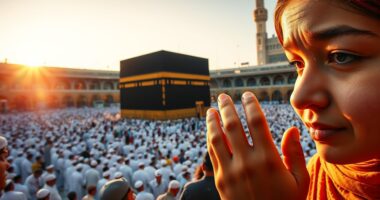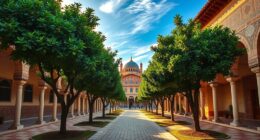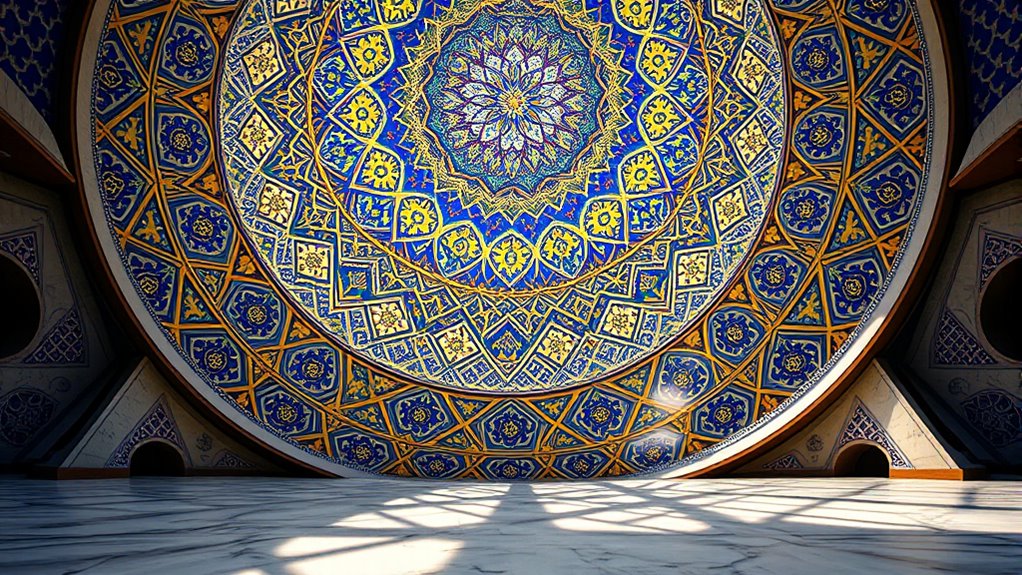

Islamic geometry is essential in architecture and design, blending spirituality, mathematics, and artistry to create visually striking structures. You’ll notice how intricate patterns symbolize unity and interconnectedness, encouraging contemplation of the divine. These geometric designs showcase human creativity and mathematical precision, enhancing the beauty and meaning of buildings. Each pattern invites you to reflect on its deeper significance and connection to both culture and spirituality. There’s much more to explore about these fascinating designs.
Key Takeaways
- Islamic geometry visually represents the infinite nature of creation, fostering a deep spiritual connection through intricate patterns.
- Architectural designs incorporate geometric patterns to enhance aesthetic appeal and evoke a sense of harmony and unity.
- Advanced mathematical techniques ensure precision in the creation of tessellations and star patterns, reflecting the marriage of art and science.
- The accessibility of these patterns invites contemplation, allowing viewers to explore spiritual themes and connections between the physical and divine.
- Islamic geometry serves as a cultural bridge, highlighting the interplay between artistic expression and mathematical principles across centuries.

Have you ever stopped to admire the intricate patterns that adorn Islamic architecture? When you look closer, you might realize these designs go beyond mere aesthetics—they’re rich in cultural symbolism and mathematical precision. Each geometric shape and symmetrical layout tells a story, reflecting a deep connection between spirituality, mathematics, and artistry. You can’t help but feel a sense of harmony when you see how these elements come together in a cohesive, beautiful whole.
As you explore mosques, palaces, and other structures, you’ll notice that the geometric patterns often represent the infinite nature of creation. The repetitive motifs convey the idea that there’s no end to beauty and complexity in the universe. This symbolism resonates with the principles of Islam, which emphasizes unity and the interconnectedness of all things. You might find yourself thinking about how these patterns invite contemplation, encouraging both the mind and spirit to engage with the divine.
The mathematical precision involved in creating these designs is nothing short of astounding. Artisans and architects relied heavily on geometry, using complex algorithms and calculations to achieve perfection. It’s fascinating to realize that the stunning tessellations and intricate star patterns you see are rooted in mathematics. You might even appreciate how this precision lends a sense of order and balance to the architecture, making each structure not just visually striking but also spiritually uplifting.
One of the most captivating aspects of Islamic geometry is its accessibility. You don’t need to be a mathematician to appreciate the beauty of these designs. As you walk through a grand hall or gaze at a stunning dome, you can feel the energy created by the symmetry and complexity. It invites you to look deeper, to explore the relationship between the physical and spiritual spheres. The patterns seem to transcend time and space, connecting you with generations of artisans who’ve poured their hearts and souls into their work.
In essence, Islamic geometry in architecture serves as a bridge between culture and mathematics. It’s a testament to the ingenuity of human creativity and the quest for spiritual understanding. When you take the time to appreciate these intricate designs, you’re not just admiring art; you’re participating in a rich cultural dialogue that spans centuries. Moreover, understanding the role of geometry in these designs can enhance your appreciation of their significance. So, the next time you encounter Islamic architecture, let yourself be drawn into its geometric embrace. You might discover a deeper appreciation for the beauty and meaning that lies within those mesmerizing patterns.

Islamic Wall Art Poster Muslim Painting Modern Islamic Art Boho Geometric Posters Hands Line Art Terracotta Artwork Quran Canvas Wall Art for Living Room Bedroom Wall Decor 16x24inchx3 Frameless
Our Artwork: High definition print on this high grade canvas created by Haruhiart is a 16×24 inch frameless…
As an affiliate, we earn on qualifying purchases.
As an affiliate, we earn on qualifying purchases.
Frequently Asked Questions
What Tools Are Used to Create Islamic Geometric Patterns?
To create Islamic geometric patterns, you’ll primarily use compass drawing and tile carving tools. A compass helps you draw precise circles and arcs, essential for intricate designs. For tile carving, you’ll need chisels and hammers to shape and engrave your patterns onto the tiles. Combining these tools allows you to achieve the elaborate symmetry and detail characteristic of Islamic art, making your patterns visually mesmerizing and mathematically profound.
How Does Islamic Geometry Influence Modern Architecture?
Islamic geometry influences modern architecture by bringing mathematical precision and spiritual symbolism into design. You’ll notice how architects incorporate intricate patterns, reflecting harmony and balance, which resonate with cultural values. These designs not only enhance visual appeal but also create spaces that inspire contemplation and connection. By using geometric forms, you can evoke a sense of unity and tranquility, blending traditional elements with contemporary aesthetics in innovative and meaningful ways.
Are There Specific Colors Associated With Islamic Geometric Designs?
You might think colors in Islamic geometric designs are arbitrary, but they actually carry deep meaning. Rich hues like blue symbolize spirituality, while green represents paradise. Gold often signifies wealth and beauty, enhancing pattern symbolism in the designs. These colors not only create visually stunning patterns but also convey messages and emotions. So, when you admire these intricate designs, remember that each color tells a story, adding layers of significance to the art.
Can Islamic Geometry Be Applied in Contemporary Art?
Absolutely, you can apply Islamic geometry in contemporary art. By integrating these intricate patterns, you create a unique cultural expression that resonates with both tradition and modernity. You might experiment with colors and forms, allowing the geometric designs to inform your artistic style. This fusion not only honors historical roots but also invites a broader audience to appreciate the beauty and depth of Islamic art in a contemporary context.
What Cultural Significance Do These Geometric Patterns Hold Today?
You might think those intricate geometric patterns are just pretty designs, but they hold deep cultural significance today. These patterns embody rich cultural symbolism, connecting people to their heritage and traditions. In contemporary art, they serve as a powerful form of artistic expression, bridging the past with the present. So, while you admire the beauty, remember that each shape tells a story, reflecting the complexity of identity and creativity in modern society.

The Art of the Islamic Tile
As an affiliate, we earn on qualifying purchases.
As an affiliate, we earn on qualifying purchases.
Conclusion
In the stunning spectrum of Islamic geometry, you’ll see shapes that sing and symmetry that soothes. This mesmerizing craft creates a connection between culture and construction, inviting you to explore elegance in every intricate detail. As you wander through beautifully balanced buildings, you’ll appreciate how these timeless trends transform spaces into sanctuaries of serenity. So, embrace the enchanting essence of Islamic geometry, and let it inspire your own designs to dance with divine distinction.

3pcs Muslims Night Lights – 3D Illusion Lamp Set with Moon Castle, Quran Book, Flower Designs – 16 Changeable Colors with Remote and Touch Control Ramadan Islamic Gifts for Kids Friends Home Deco
Unique Muslim-Inspired Designs: This 3D Illusion night light set includes three beautifully crafted pieces: a Moon Castle, a…
As an affiliate, we earn on qualifying purchases.
As an affiliate, we earn on qualifying purchases.

Islamic Biomorphic Patterns: Creating Motifs Inspired by the Natural World
As an affiliate, we earn on qualifying purchases.
As an affiliate, we earn on qualifying purchases.