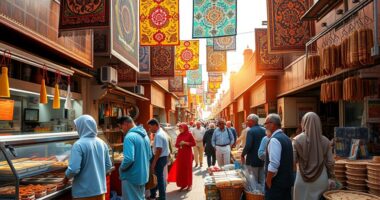
The Islamic Golden Age had a profound cultural impact on science and art, fostering collaboration among diverse scholars and artists. Innovations in mathematics, medicine, and architecture emerged as knowledge transcended borders. Artistic styles flourished, blending influences from different cultures into intricate designs and calligraphy. This era laid the groundwork for modern advancements and continues to inspire today’s practices. You’ll find interesting insights into how these vibrant exchanges shaped our contemporary world.
Key Takeaways
- The Islamic Golden Age fostered collaboration among diverse scholars, enhancing scientific and artistic innovation through shared knowledge.
- Mathematicians like Al-Khwarizmi developed algebra, laying foundational principles still used in modern mathematics and science.
- Translations of ancient texts preserved critical knowledge, revitalizing classical ideas and influencing European intellectual thought.
- Artistic styles blended geometric patterns and calligraphy, creating unique visual forms that continue to influence contemporary design.
- The era’s achievements highlight the importance of cultural interconnectedness in driving progress in both science and the arts.

The Islamic Golden Age, which flourished from the 8th to the 14th century, profoundly shaped various aspects of culture that continue to influence us today. One of the most significant impacts was in the worlds of science and art. As you explore this era, you’ll notice how medieval innovations emerged from a rich tapestry of cross-cultural exchanges. Scholars, artists, and thinkers from diverse backgrounds came together, sharing knowledge that transcended borders and traditions.
The Islamic Golden Age forged a remarkable blend of science and art through vibrant cross-cultural exchanges that still resonate today.
In the domain of science, the Islamic Golden Age was marked by groundbreaking advancements. You’d find mathematicians like Al-Khwarizmi, who pioneered algebra, laying the groundwork for modern mathematics. This period also saw the translation of ancient texts, particularly from Greek and Roman scholars. These translations not only preserved knowledge but also allowed it to flourish anew. You can see how these cross-cultural exchanges allowed scholars to build upon one another’s work, leading to innovations that changed the course of history.
In fields like medicine, the contributions were equally impressive. Figures such as Avicenna wrote influential texts like “The Canon of Medicine,” which became a standard reference in Europe for centuries. As you explore this era, you’ll notice how physicians treated patients with an understanding of both physical and psychological health—an insight that resonates with modern practices. The cross-pollination of ideas between cultures led to a better understanding of the human body, which continues to inform contemporary medicine.
Art, too, thrived during the Islamic Golden Age. The fusion of various artistic styles gave rise to unique creations. When you look at Islamic architecture, for instance, you can’t help but admire the intricate designs and geometric patterns that reflect a blend of influences—from Persian to Byzantine. This period also saw advancements in calligraphy, where artists transformed writing into a visual art form. Each stroke of the pen not only conveyed meaning but also expressed beauty, showcasing the cultural richness of the time.
As you reflect on the cultural impact of the Islamic Golden Age, it’s clear that the legacy of medieval innovations and cross-cultural exchanges remains entrenched in our world today. Your understanding of science and art has been profoundly shaped by this era, reminding you of the importance of collaboration and shared knowledge across cultures. The echoes of this golden age continue to inspire you, urging us all to appreciate the interconnectedness of human achievement. Furthermore, the period also exemplified the value of diversifying investments in knowledge, as scholars drew from various disciplines to enhance their understanding and expertise.

Islamic Golden Age: How Muslim Minds Shaped the Modern World | A Guide For Young Muslim Kids Ages 8+ (Islam Made Easy For Kids)
As an affiliate, we earn on qualifying purchases.
As an affiliate, we earn on qualifying purchases.
Frequently Asked Questions
What Were the Major Inventions During the Islamic Golden Age?
During the Islamic Golden Age, you’d discover major inventions like algebra, which laid the groundwork for modern mathematics. You’ve got advancements in optics, leading to the development of lenses, and innovations in medicine, such as surgical instruments and techniques. These technological advancements influenced the European Renaissance, igniting a wave of renaissance innovations. The astrolabe, used for navigation and astronomy, also emerged, showcasing the era’s brilliance and its lasting impact on future scientific endeavors.
How Did Trade Influence Cultural Exchange in This Period?
Trade markedly influenced cultural exchange during this period by connecting diverse regions through established trade routes. As you explore these routes, you’ll notice how merchants shared not only goods but also ideas, beliefs, and artistic styles. This cultural diffusion enriched societies, blending traditions and fostering innovation. You’ll find that the interactions between different cultures led to advancements in science and art, creating a vibrant tapestry of knowledge and creativity that shaped the era.
Which Scholars Were Most Influential in the Islamic Golden Age?
During the Islamic Golden Age, you’ll find that medieval scholars like Al-Khwarizmi and Avicenna emerged as intellectual giants. Al-Khwarizmi’s work on algebra laid the foundation for modern mathematics, while Avicenna made significant advances in medicine and philosophy. Their contributions didn’t just influence their contemporaries; they also shaped future generations across the globe. By studying these figures, you can appreciate the depth of knowledge developed during this remarkable period.
What Role Did Women Play in Science and Art Then?
Interestingly, around 40% of scientists during the Islamic Golden Age were women, challenging typical gender roles of the time. Women considerably contributed to both science and art, often serving as scholars, patrons, and creators. You’d find them in medical fields, writing manuscripts, and influencing artistic expressions. Their involvement not only enriched the cultural landscape but also laid groundwork for future generations, demonstrating that women’s contributions were essential to advancements in knowledge and creativity.
How Did the Islamic Golden Age Affect Europe?
The Islamic Golden Age profoundly affected Europe through medieval transmission of knowledge. You’d notice how scholars translated Arabic texts into Latin, introducing new ideas in mathematics, astronomy, and medicine. This intellectual transmission revitalized European scholarship, leading to the Renaissance. You see, many foundational concepts, like algebra, originated from this period, reshaping European thought and paving the way for modern science. The cross-cultural exchange truly transformed the intellectual landscape of Europe.

BoiCkyo Islamic Wall Art Decor Metal and Stainless steel- Handmade Arabic Calligraphy Quran Verses for Muslim Home, Living Room & Pray Room Wall Decor, Eid Ramadan Gift for Families,set of 3
✨PREMIUM ISLAMIC WALL ART – Hand-crafted with dual-tone stainless steel and metal (inner gold ring stainless steel, outer…
As an affiliate, we earn on qualifying purchases.
As an affiliate, we earn on qualifying purchases.
Conclusion
In wrapping up, it’s clear that the Islamic Golden Age was a beacon of knowledge that illuminated the world of science and art. Its influence still resonates today, reminding us that the seeds of innovation planted centuries ago continue to bloom. By embracing this rich heritage, you can appreciate how interconnected our cultures truly are. After all, when you dig a little deeper, you’ll find that the past is not just history—it’s the foundation of our future.
Myth Qholve Blue Mosque Building Block Set Istanbul Türkiye Sultan Ahmed Mosque Architecture Model Kit for Adults Educational Display Toy
Iconic Architectural Landmark in Brick Form:Recreate the beauty of Istanbul’s Sultan Ahmed Mosque—also known as the Blue Mosque—with…
As an affiliate, we earn on qualifying purchases.
As an affiliate, we earn on qualifying purchases.

Al-Khwarizmi: The Beginnings of Algebra
Used Book in Good Condition
As an affiliate, we earn on qualifying purchases.
As an affiliate, we earn on qualifying purchases.