
Muslim inventors and scientists have profoundly shaped world knowledge, revolutionizing fields like mathematics, medicine, and astronomy. They’ve established the Scientific Method, advanced algebra through Al-Khwarizmi, and set the foundation for modern medicine with Avicenna’s works. Scholars refined celestial models, inspiring future astronomers. Their contributions preserved ancient knowledge and sparked the European Renaissance, influencing generations of thinkers. If you’re curious, there’s much more to uncover about their lasting impact on science and technology.
Key Takeaways
- The Scientific Method established by Muslim scholars revolutionized scientific inquiry, emphasizing observation and experimentation across various disciplines.
- Al-Khwarizmi’s work laid the foundation for algebra and algorithms, significantly influencing modern mathematics and computing.
- Avicenna’s “The Canon of Medicine” integrated empirical observation and clinical trials, shaping the practice of modern medicine.
- Astronomers like Al-Battani improved the Ptolemaic model, providing accurate celestial calculations that impacted European astronomy and the Copernican revolution.
- The preservation of ancient texts and innovative ideas during the Islamic Golden Age inspired the European Renaissance and future scientific collaboration.
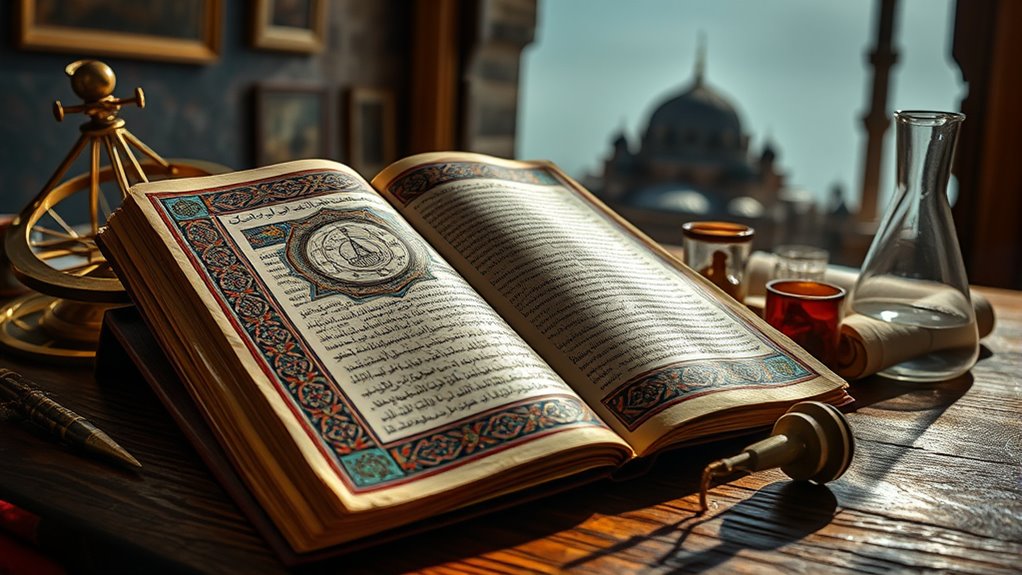
Have you ever wondered how much of our modern world owes its existence to Muslim inventors and scientists? During the Islamic Golden Age, which spanned from the 8th to the 14th century, scholars and innovators in the Islamic world made groundbreaking contributions that laid the foundation for many fields of knowledge we rely on today. They didn’t just preserve ancient texts; they expanded upon them, developing new ideas and methods that propelled humanity forward.
One of the most significant contributions of these scholars was the establishment of the Scientific Method. Unlike earlier approaches to science, which often relied on philosophical reasoning and speculation, the Muslim scholars emphasized observation, experimentation, and evidence. They believed that knowledge should be acquired through systematic inquiry, and this rigorous approach allowed them to make remarkable discoveries in various disciplines, including mathematics, astronomy, medicine, and chemistry.
The establishment of the Scientific Method by Muslim scholars revolutionized knowledge through systematic inquiry, emphasizing observation and experimentation.
Take Al-Khwarizmi, for instance, who’s often called the father of algebra. He introduced the concept of algorithms and laid the groundwork for modern mathematics. His work not only revolutionized mathematics but also influenced European scholars when they later encountered his texts during the Renaissance. You might not realize it, but the very term “algebra” derives from his famous book “Al-Kitab al-Mukhtasar fi Hisab al-Jabr wal-Muqabala,” which means “The Compendious Book on Calculation by Completion and Balancing.” This reflects how intertwined math and practical applications became during this period.
In medicine, figures like Avicenna (Ibn Sina) wrote “The Canon of Medicine,” a exhaustive text that served as a standard reference in Europe for centuries. His approach combined the Scientific Method with empirical observation, emphasizing the importance of clinical trials and the study of diseases, something that resonates with modern medical practices today.
Astronomy also flourished, with scholars like Al-Battani refining the Ptolemaic model of the universe and providing precise calculations of celestial bodies. Their advancements in this field directly influenced later European astronomers, leading to the Copernican revolution. Additionally, these scholars’ contributions to remote hackathons would inspire innovation and collaboration in future scientific endeavors.
Top picks for "muslim inventor scientist"
Open Amazon search results for this keyword.
As an affiliate, we earn on qualifying purchases.
Frequently Asked Questions
How Did Muslim Inventions Influence the Renaissance in Europe?
Muslim inventions profoundly influenced the Renaissance in Europe through medieval trade and scholarly translation. You’ll notice that as trade routes opened, European scholars encountered advanced knowledge in mathematics, astronomy, and medicine. They translated key texts from Arabic to Latin, sparking new ideas and innovations. This exchange of knowledge revitalized European thought, leading to advancements in art, science, and philosophy that defined the Renaissance period. Your understanding of this connection reveals a rich cultural interplay.
What Modern Technologies Stem From Ancient Muslim Scientific Discoveries?
Many modern technologies, like algorithms and advancements in optics, trace back to medieval innovations. Did you know that around 80% of the mathematical principles used in computer science are rooted in ancient Islamic scholarship? This legacy forms a essential part of our scientific heritage. You’ll see how techniques for navigation and even the concept of zero, which emerged from this era, continue to shape today’s technology and communication methods.
Are There Any Contemporary Muslim Inventors Making Significant Contributions Today?
Yes, there are contemporary innovators making significant contributions today. You can find Muslim inventors leading in fields like technology, medicine, and renewable energy. For instance, individuals are developing modern breakthroughs in artificial intelligence and biotechnology, creating solutions that tackle global challenges. These innovators not only advance their fields but also inspire the next generation of thinkers and creators. Their work exemplifies how innovation continues to thrive across cultures and backgrounds.
How Did Cultural Exchanges Impact Muslim Scientific Advancements?
Cultural exchanges played a pivotal role in boosting Muslim scientific advancements. Through cultural diffusion, ideas and knowledge flowed between various civilizations, allowing you to learn from different philosophies and discoveries. This knowledge exchange fostered innovation and collaboration, enabling breakthroughs in fields like mathematics, astronomy, and medicine. By embracing diverse cultures and sharing insights, you helped create a rich tapestry of knowledge that propelled scientific progress during this vibrant era.
What Challenges Did Muslim Scientists Face Historically in Their Pursuits?
You wouldn’t believe the hurdles Muslim scientists faced! Imagine battling medieval persecutions that felt like a storm cloud following them everywhere. They navigated a world rife with scholarly censorship, where their groundbreaking ideas often met resistance instead of applause. With every innovation, they had to dodge the arrows of ignorance and fear, pushing forward against an overwhelming tide. Yet, despite these challenges, they forged ahead, leaving an indelible mark on history.
Conclusion
In summary, the significant strides of Muslim inventors and scientists shape our understanding of the world today. Their remarkable revelations and relentless research have revolutionized diverse disciplines, leaving a lasting legacy. By appreciating their contributions, we not only honor their hard work but also inspire future generations to innovate and imagine. So, let’s celebrate the brilliance and boldness of these pioneers who’ve paved pathways to progress, proving that knowledge knows no bounds.